Why did you choose the koto in particular as your partner instrument?
There are two main reasons. First, the koto is one of the oldest traditional Japanese instruments and, like the viola, it is a string instrument. It has developed a musical language where resonance, space and the placing of tones within silence are more important than harmonic progression. That makes it a very natural counterpart to the viola in a project focused on timbre and time.
Second, my connection is also personal. When I was in university in Japan, I met a fellow student who specialized in traditional instruments and contemporary music. Whenever I thought about Japanese instruments, this person—and the koto—came to mind. So for my very first project that directly addresses Japanese tradition, it felt right to begin with this instrument. Of course, I would love to expand later toward other instruments like shamisen or shakuhachi, but starting with koto already opens an incredibly rich field of possibilities.
Let’s turn to your own path. Could you outline your musical background and current situation?
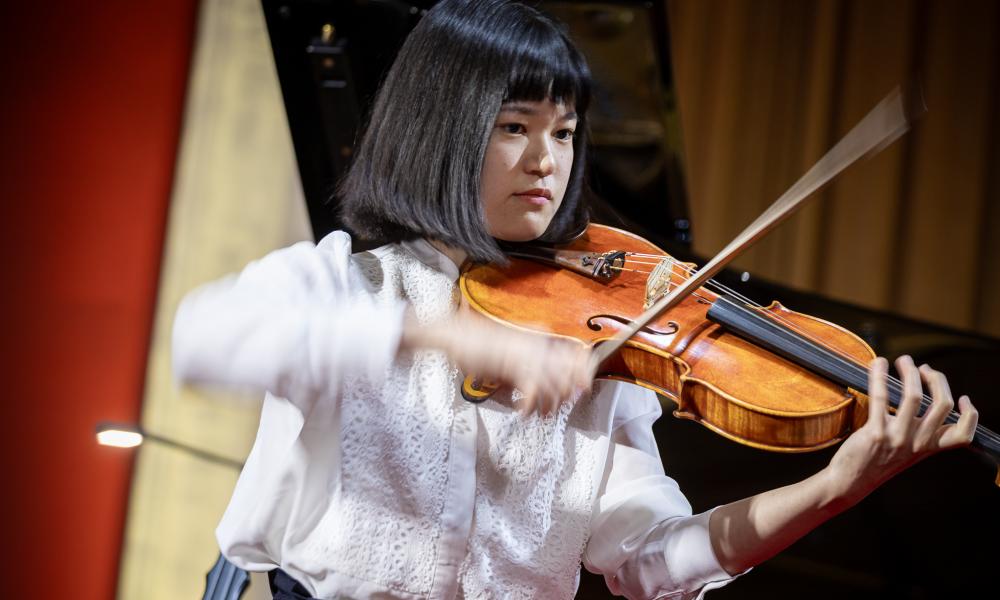
I started on the violin when I was three. Around the age of twelve, I was playing in a junior orchestra that had too few violists. They asked whether I could try the viola, and I agreed quite casually. But when I started playing it, I was immediately drawn to the sound. It felt very close to my own voice—warm, speaking, a bit inward. I gradually realized how much expressive potential the instrument has, and I decided to switch. So I’ve now been playing the viola for about ten years.
I studied first at Tokyo University of the Arts in Japan, where I spent two years, and then transferred to Germany to complete my bachelor’s degree. I finished that in Frankfurt after another two years and am now in my first year of my master’s studies, living and studying in Frankfurt.
You’ve studied in both Japan and Germany. How do you perceive the differences in the “viola culture” between these two contexts?
The difference is quite striking. In Japan, the viola is still very strongly perceived as an orchestral instrument—one of the inner voices in a larger texture. At music universities, a lot of focus is placed on the standard orchestral audition repertoire, because many students aim for orchestral careers or chamber music. There are, of course, soloists and contemporary specialists, but the overall image of the viola remains rather functional.
In Europe, I feel that the viola’s potential as a solo and experimental instrument is much more visible. The repertoire is expanding, and there is growing interest in new works that explore the instrument’s full range of colors. For a violist who is interested in contemporary creation, it is an incredibly stimulating environment.