How do those short rounds reveal a conductor’s abilities?
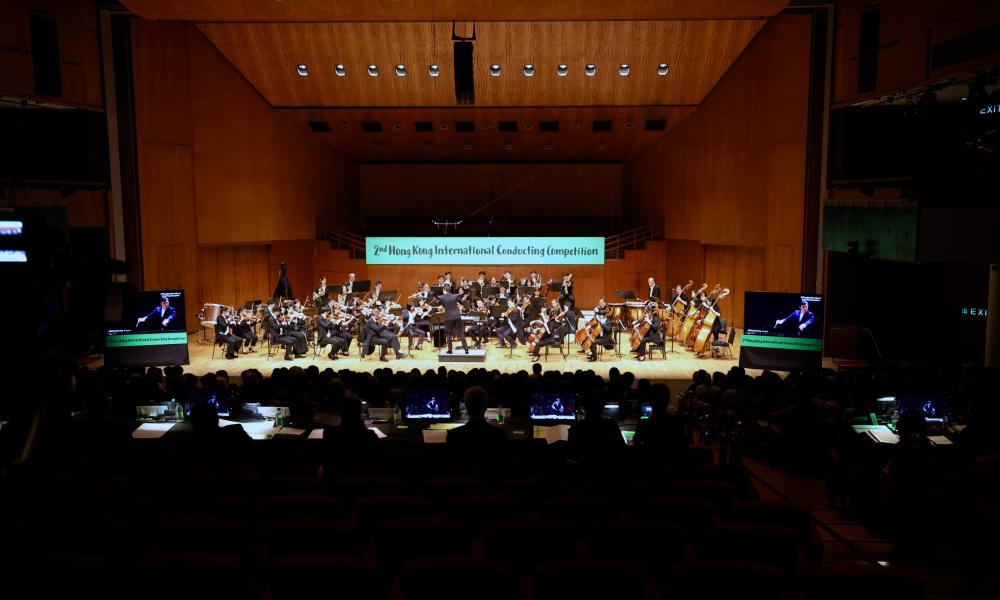
Surprisingly fast. In five, six, or seven minutes you can detect clarity of intention, how a conductor sets tempo, balance, phrasing and how they connect with players. I remember a round where every candidate conducted Johann Strauss’ “Fledermaus”- Overture, one after another. You’d expect the orchestra to settle into a certain routine by the seventh performance… but the quality kept changing, and it became crystal clear that the conductor really makes a difference. That’s a useful side effect: the audience, and especially the jury, can observe how much a conductor directly influences precision, ensemble, and tempo. It’s striking how often the same orchestra can sound like a different ensemble depending on who’s on the podium.
Do candidates get rehearsal time with the Hong Kong Sinfonietta?
Early rounds are immediate performances before the jury, so there’s no rehearsal time. Before the final, however, each finalist will be allowed a full session to rehearse the entire final programme with the orchestra—without the jury listening. Rehearsing the orchestra under constrained conditions to simulate real-life scenarios is also one of the judged elements in the early rounds: limited rehearsal time to prepare a long work and an expectation that candidates prioritize the most crucial passages—tempo transitions, movement openings, balance points. Some conductors fall apart because they focus on the slow introduction and run out of time, while others are highly organized and precisely manage transitions within the allotted rehearsal time. That skill—achieving the best possible result in a short rehearsal—is essential to the job.
How involved is the orchestra in the competition, and how do they handle the frequent changes of conductor?
Hong Kong Sinfonietta is exemplary. They really approach each round with professional discipline, adapting to a new conductor every ten or fifteen minutes. They are flexible, attentive, and fair: you don’t sense favoritism if they prefer one candidate’s approach. That evenness is crucial. Also, members of the orchestra participate in the jury—traditionally the concertmaster and another player sit on the panel—so the orchestra’s perspective is directly represented in the evaluation.
Tell us about the jury and scoring system. How do you balance objectivity and discussion?
You may know that I’ve chaired also other competitions—being President of the ARD competition in Munich for some years—so I’ve experienced many different systems. For the early rounds, a simple yes/no combined with numerical points works best. The two-tier system gives an objective snapshot but also flags borderline cases for discussion. For example, if yes/no votes are split 5–4 but point averages suggest the opposite, that signals the need for a conversation. As the competition advances, discussion becomes more important; the further you go, the greater the responsibility to talk things through. Disclosing personal scores within the jury helps curb extreme outliers and gives jurors a chance to explain unusual marks. I also believe juries should be diverse: alongside conductors, we include orchestra managers and agency representatives who bring practical perspectives—what programming and hiring professionals need to know. That broadens the assessment beyond purely personal artistic taste.
What kind of conductor are you hoping to find at the Hong Kong International Conducting Competition?
We’re looking for an artist, not merely a technician. Of course technique and score knowledge matter, but the decisive quality is musical personality—someone who has something meaningful to say through the orchestra and who inspires players and listeners. It’s not about the most beautiful baton gestures; sometimes a juror should judge with “eyes closed” and listen for music that reaches the audience. Ideally, the winner is a conductor whose musicianship suggests longevity—someone who will continue to communicate and inspire over decades. That said, the repertoire is broad so different candidates can showcase diverse strengths. One perhaps unusual element of the competition is that we invite all finalists to give a short spoken introduction to the audience about the programme they will conduct, which enables the jury to see a more complete picture of the finalists’ on-stage personality. We don’t expect a single person to excel in everything; no artist has to do everything. But over the course of the competition you can sense whether someone can express consistent musical ideas across varied material, and whether someone is a good communicator.
How do you treat candidates who excel in one area but underperform in another?
There’s a limit to how much a candidate can fail and still be competitive. Applicants know the repertoire in advance; if they feel something is completely outside their scope, they’d be unwise to apply. Still, major discrepancies are rare. The overall picture is what counts—technical command, musical communication, and the ability to lead an ensemble. The competition asks candidates to make choices, and those choices reveal priorities and maturity.