LEIPZIG, GERMANY

WFIMC Café: Miha Zhu

The 2026 Leipzig Bach Competition winner talks about her life between modern and baroque violin, between orchestra and solo playing, and her great passion for Johann Sebastian Bach.

WFIMC: When you think back on the Bach Competition in Leipzig, what’s the very first thing that comes to mind?
Miha Zhu: It was an incredibly exciting journey—personally and musically. Bach’s music is so highly structured and yet so profoundly human that you can’t hide behind it. There’s a tremendous honesty in his writing. That feeling of having to be completely sincere in the music is what stayed with me most. 

You’re closely associated with early music. Could you tell us a bit about where you live and how Baroque music became such a central part of your life?
I was born in Berlin, and today I divide my time between Berlin and Halle. In Halle, I’m a member of a Baroque ensemble, which has made historically informed performance a real specialty for me. I play Baroque violin there—with Baroque bow and gut strings—in a wide range of repertoire: of course a lot of Bach, but also Handel, who was born in Halle, and many other Baroque composers. 

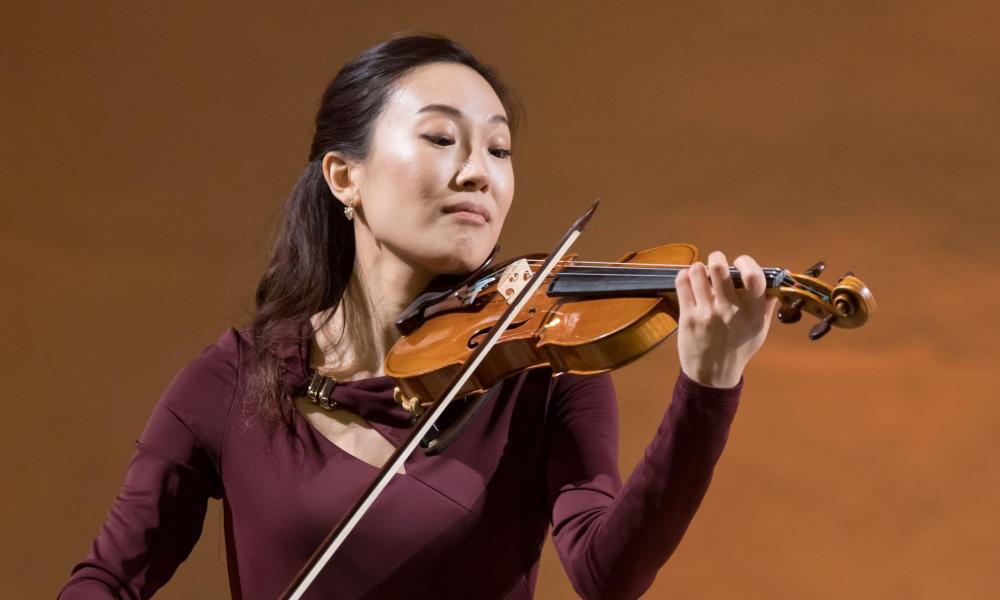
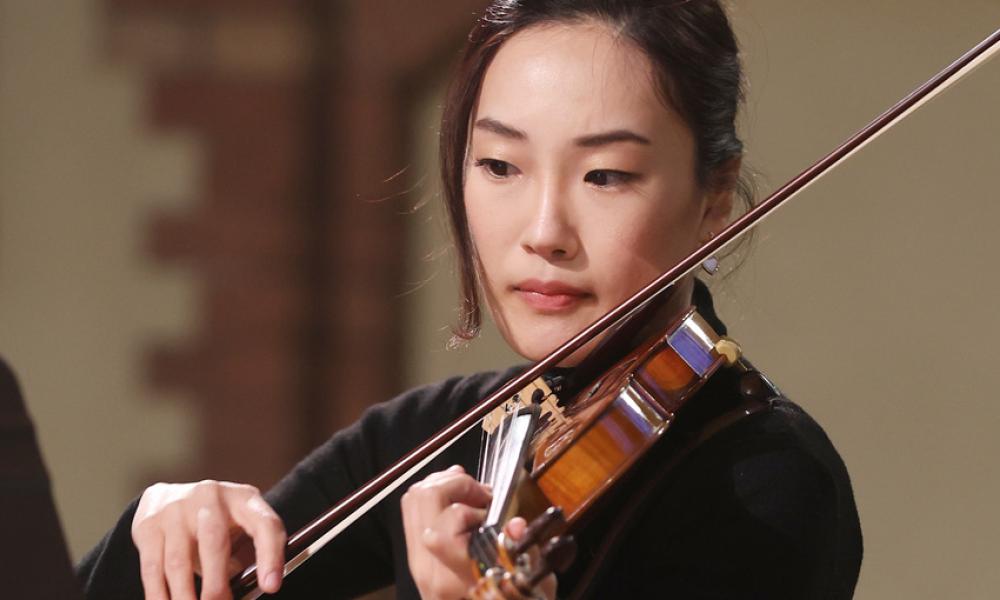
Miha Zhu

The Bach Competition is very different from, say, the Queen Elisabeth Competition or the ARD Competition—both in terms of repertoire and in the jury, which includes leading Baroque specialists. How did you experience that atmosphere?
For me, it was an very special situation. I’ve been listening to artists like Rachel Podger for many years; she has been a huge idol for me. To sit down and play for her, and for specialists like Reinhard Goebel, was really a lifelong dream. That alone made the competition unique and deeply meaningful. 

Were there any moments from that week in Leipzig that you’ll particularly remember?
There were the usual “moments of panic”—like when a button fell off the back of my dress shortly before going on stage, and we had to improvise a quick solution so it wouldn’t slip down. Musically, one of the most memorable situations was the final rehearsal. We were under the impression we would have three hours of rehearsal with the orchestra, so we prepared in great detail—scores, articulations for every voice, everything. In the end, we had only about half an hour, basically a single run-through and a brief talk about tempo, and that was it. It was challenging in the moment, but in hindsight almost funny, because we later realized that more rehearsal time had actually been planned; it was just a miscommunication. 

You perform both on modern and Baroque instruments. How did you decide what set-up to use for the competition?
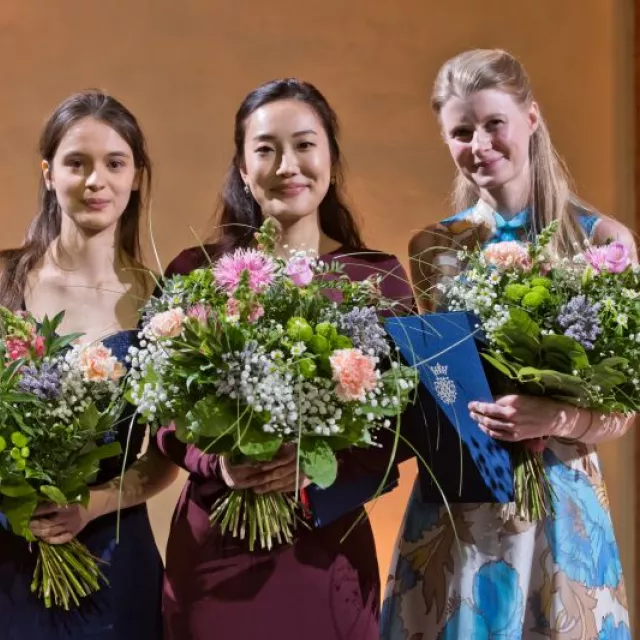
In my Baroque ensemble in Halle, we all play fully in the spirit of historical performance practice: Baroque violins, Baroque bows, gut strings. For the competition, however, I chose to play a modern violin with a Baroque bow. For me, that is the most uncompromising solution because it’s the set-up I feel most at home with. I’ve simply spent many more years of my life on the modern violin, so I don’t have to deal with an additional layer of technical adjustment on top of everything else. Of course, I could have played a Baroque violin as well. In fact, the competition category was simply “violin,” so there were pure Baroque violinists and modern violinists, and even some mixed set-ups—modern instruments with Baroque tuning and so on. In the final, Cosima Soulez-Larvière and I were the only modern violinists, and Celeste Klingelschmitt, who won second prize, was the sole Baroque violinist. 

People often ask how it’s possible to compare such different instruments and approaches—Baroque vs. modern. How do you see it?
It’s a valid question, because a Baroque violin can feel like a different instrument. At the same time, I wouldn’t say they are worlds apart. The Baroque violin is more “authentic” in terms of historical set-up, but both are ultimately tools to serve Bach’s music. The differences are real, but what you are always evaluating in a competition is musical understanding, sound, rhetoric, and personality. 
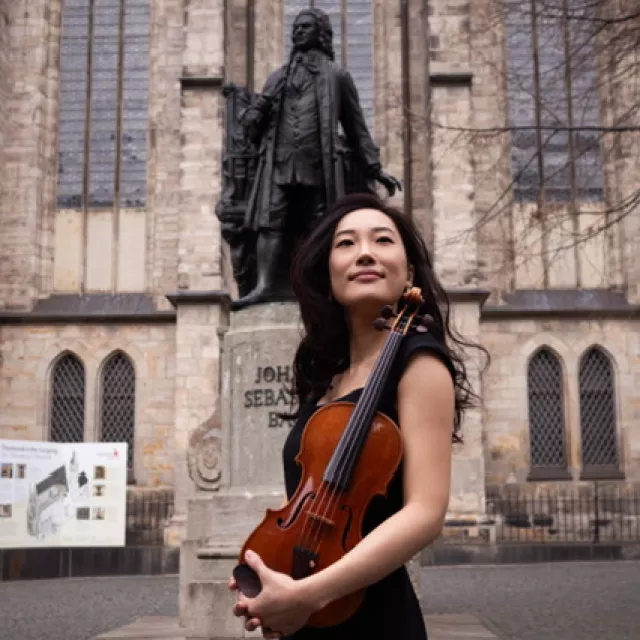
Miha Zhu at the Thomaskirche, Leipzig

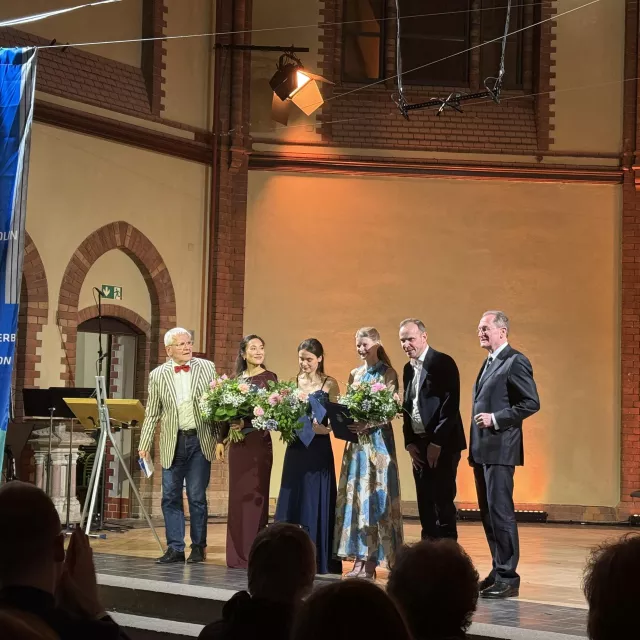
Bach Competition Awarding Ceremony 2026

Was this your first major competition success?
I’ve taken part in other competitions before, but I never achieved anything comparable to this first prize in Leipzig. This result is definitely a milestone for me. 

Could you tell us more about your background and musical education?
I’m a native Berliner. My parents come from South Korea and China, so I’m three-quarters Korean and one-quarter Chinese. I grew up in Berlin and entered Berlin University of the Arts (UdK) when I was nine. I later completed my bachelor’s degree there. For my master’s, I wanted a change of perspective while still staying in Berlin, so I moved to the Hanns Eisler School of Music. After that, I won an orchestra position in Halle and, in parallel, began my concert exam in Dresden. At the moment, I’m juggling both my orchestral work and my advanced studies. 

You mentioned Halle and the Baroque ensemble. How does playing in an opera orchestra influence your preparation for a competition like this?
In a very positive way. Of course, it can be difficult to prepare for a major competition alongside a full schedule at the opera house. Sometimes I have three services a day, and on those days there simply isn’t much time for “extra” practicing. But in the long run, I had been working toward the Bach Competition for quite some time—about eight or nine months of focused preparation before the event. The advantage of opera work is stamina: playing operas that last three or four hours builds an endurance that’s extremely helpful in a competition context. It trains you not only physically, but also mentally, to stay focused and present for long stretches of time. We also play Baroque operas—right now, for example, we’re in the middle of the Handel Festival in Halle, with performances of Handel’s operas. Regardless of the repertoire, that ability to maintain energy and concentration over several hours is invaluable. 

You mentioned your family background. How closely are you connected with Asia today?
My connection is primarily through family at the moment. I’m often in touch with relatives in South Korea and China, but in terms of where I feel at home, Germany is really my base. In any case, I speak both Korean and Chinese, which makes it feel very natural to move between these cultures. 

Miha Zhu ©Bach-Wettbewerb Leipzig / Gert Mothes

How did you organize your preparation for the competition around your opera schedule?
It comes down to learning how to manage time efficiently and to practice in a very focused way. Over those eight or nine months, there were intense phases when I had to be extremely disciplined, and other times where rehearsals and performances took over and there was very little room for extra work. You learn to accept that fluctuation and still keep the bigger goal in sight. 

Do you have any pre-concert rituals—especially for something as high-pressure as the Bach Competition?
This competition actually taught me something very important: that perfection is not everything; self-confidence matters just as much. At a certain point, you have to stop trying to control every single note and tell yourself, “Now I have the courage to go on stage and let the music speak.” So my “ritual,” if you will, is more mental than anything else. It’s about trusting the work I’ve done and allowing the music to unfold, instead of trying to micromanage every bar at the last second. 

How do you deal with nervousness or stage fright in such situations?
For me, the key is acceptance. I remind myself that it’s completely normal to be nervous when you’re about to perform in front of a jury that includes people you’ve admired for years. Just acknowledging that it’s human to feel that way helps a lot. Then it’s about believing in yourself—repeating inwardly, “I can do this.” Physically, of course, nerves can show: the bow might shake a little, especially with a light Baroque bow. But I try not to exaggerate that in my mind, because the audience usually doesn’t notice these things nearly as much as we do. Keeping that in mind is very calming. Once I’m deeply inside the music, my attention is so fully engaged that there isn’t much space left for worrying about how I look or whether my hand is trembling slightly. 

These days, performances are often livestreamed to audiences around the world. Does that add another layer of pressure for you?
You’re always aware that you’re being watched—by the jury in the hall and by people online. Of course I think about posture—“Keep your back straight”—and details like that. But beyond a certain point, performing for a livestream doesn’t feel fundamentally different from playing for a full hall. What moved me most was the feedback I received afterwards. Some of my family members in South Korea were able to watch and cheer me on from afar. That’s incredibly touching, and it shows how music can bring people together across great distances. 

Now that you’ve won first prize in Leipzig, what’s next?
I’ll be returning to the Bachfest Leipzig, where I’ll perform with last year’s prize winner, Jan Čmejla. We’ll play the Mendelssohn Double Concerto, and I’ll also have the opportunity to perform Bach’s A minor Violin Concerto again. Looking further ahead, I hope to develop more projects that place Bach in dialogue with contemporary composers. I’m especially interested in voices like the Korean-German composer Isang Yun. In his “Royal Theme” for example, he carries Bach’s legacy into the present and reinterprets it in a modern language. Music like this encourages me to explore further: to look for connections between eras, to show how Bach’s spirit lives on in completely different musical languages, and to build programs that allow those dialogues to unfold on stage. That’s a direction I would very much like to pursue in the coming years.


Miha Zhu, a graduate of the Berlin University of the Arts and the Hanns Eisler School of Music, has studied with Viviane Hagner and others and since 2024 has been a student of Natalia Prishpenko at the Carl Maria von Weber School of Music Dresden. She also holds a position with the Staatskapelle Halle and the associated Halle Handel Festival Orchestra.

© WFIMC 2026 / FR