TRONDHEIM, NORWAY

WFIMC Café: Matthew Rhodes

Following his victory at the Trondheim International Conducting Competition, Matthew Rhodes reflects on his Nordic education, the delicate balance between confidence and arrogance, and the moment he decided to loosen the reins.

WFIMC: Your connection with the Nordic countries runs deep. How did you end up in Stockholm?

Matthew Rhodes: Honestly, by coincidence. I finished my bachelor’s degree in Finland in the middle of COVID and came home unsure what to do next. Like many musicians at that time, I was asking myself: is this career going to work out?
A friend studying in Stockholm suggested I apply there: a very good professor, plenty of orchestra time. I thought, why not? I spent two years doing my master’s, including an Erasmus exchange in Oslo, so I managed to experience Helsinki, Stockholm and Oslo. Three Skandinavian countries- only Denmark is missing! Afterwards, I stayed in Stockholm for another two years, freelancing.
When I arrived, I thought I would do a degree and move on. I didn’t realise how important Sweden would become to my musical development.

What made it such a valuable place to develop?

Sweden has a very rich musical culture, with excellent orchestras and opera houses at both the large and the small scale. Those smaller institutions are particularly important for young artists. Some are in small towns a long way from anywhere else, but they offer opportunities that are much less common in Britain.
There is also the great feeling that people working in the arts are treated like anyone else in society. For orchestral musicians, technicians and backstage staff, there are good employment rights and a strong professional culture. You sense that stability when you visit orchestras: the atmosphere is positive, and people work hard.
Britain has fantastic artistic institutions too, but it is a very different system. I suspect many British musicians would quietly rather like the Nordic setup.

Going back to the beginning: was conducting always the ambition?

Not at all. My instrument was—and still is—the flute. I started at school when I was about six or seven, with my friends. Music was something I loved, but it was my hobby. I’m the only musician in my family, and I encountered very few professional musicians apart from my teachers. It simply didn’t occur to me that this could be a career.
My flute teacher ran a little flute orchestra and one day suggested I conduct a piece. Thankfully, she chose something quite easy. I enjoyed it and started wondering where I could learn.
That is surprisingly difficult when you know nothing: to get into a conducting course, you often already need substantial conducting skills. Eventually, I found that the junior college at the Royal Northern College of Music offered conducting. I rang the principal, Karen Humphreys, who said they had never had a first-study conductor, but I should come and audition.
Ewa Strusińska was teaching there. They more or less had to invent the audition on the spot. I could start the musicians, but I realised I didn’t actually know how to stop them! I played piano, Bach chorales and scores, and they agreed to teach me.

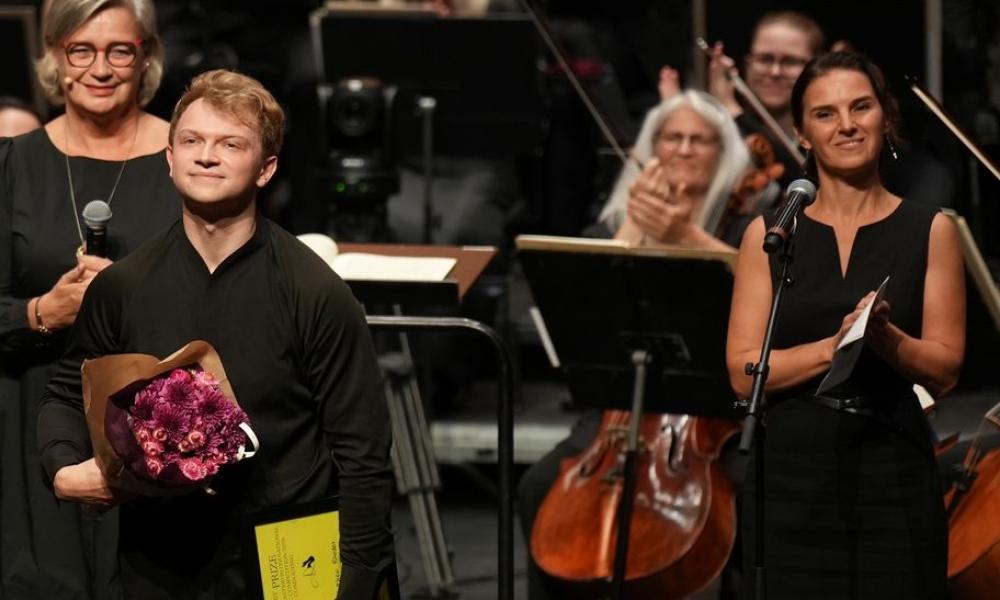
Matthew Rhodes and the Chair of the Trondheim Jury, Oxana Lyniv ©TSO

When did that become a professional commitment?

The junior college gave me a wonderfully supportive space to experiment. I wanted to set up an orchestra, and they let me. But at eighteen I still thought it might be time to enter the “real world”. I accepted a university place in politics and economics.
During the summer before I was due to start, something didn’t feel right. Eventually, I emailed to say I wasn’t coming. I stayed another year at juniors and decided to audition for conducting schools. If it didn’t work, I could do something else—but I needed to try.
There was never one grand moment when I decided to become a conductor. It was a series of things that felt right, or that I enjoyed. And you really do have to enjoy this profession. All those hours alone with a score, all the travelling: you cannot make yourself do it unless you love it. I started because it was fun, and I still think it is.

How do you develop the confidence to stand in front of an orchestra without slipping into arrogance?

Experience helps. At first, standing on a podium was terrifying. A hundred people watch everything you do, every movement and every word. Gradually, you accept that being watched is part of the job.
But confidence and arrogance are very different, and orchestras can tell the difference. As a young conductor, you want to lead, but finding that balance is difficult. What you eventually learn is that authority and respect come from the music: from being prepared, knowing what you want and having well-reasoned ideas.
If I’m nervous, I try to think only about the music, rather than what my hands are doing. Things can still go wrong, but musicians are remarkably willing to forgive mistakes if they see a genuine musical intention.
I used to be so self-conscious that I was afraid to take risks in case the orchestra disliked them. But a hundred musicians will have a hundred opinions. The point is not universal agreement; it is to communicate your interpretation honestly enough that you can work together productively.

A competition adds a jury and a severe time limit. How do you avoid rehearsing for the jury rather than responding to the orchestra?

You can start playing mind games with yourself: the jury wants to hear something about bowing, something about intonation, something about phrasing. It is possible to approach a competition by ticking those boxes, and people have done very well that way.
For me, though, the healthiest approach is to behave as I would without a jury. Limited rehearsal time is not unique to competitions; it happens in professional life too.
If I’m nervous, the worst thing I can do is think, “Now I need to find an articulation problem.” That only makes me more tense. If I treat it as a normal rehearsal and respond to what is actually happening, I relax. And the more relaxed I am, the easier it becomes to connect with the orchestra.

What distinguished your experience in Trondheim?

The orchestra’s musical responsiveness. That means more than following a tempo: could they follow an emotional intention, a colour, a character? In Trondheim, they were very willing to come with me in that sense, often through gesture rather than explanation.
The repertoire also demanded very different things from us: Beethoven and Stravinsky, a concerto and a contemporary piece, then Brahms and Mozart in the final. It was rewarding to explore those differences with the same musicians.
I find the Viennese Classical repertoire particularly difficult to conduct because so much of it doesn’t actually need conducting. You can very easily make it worse. You have to offer something beyond beating time, because the musicians don’t need that.
The whole week also felt unusually relaxed and intimate. Competitions can make you feel caught up in a huge machine. Trondheim managed to create an environment in which you could feel safe and be yourself.
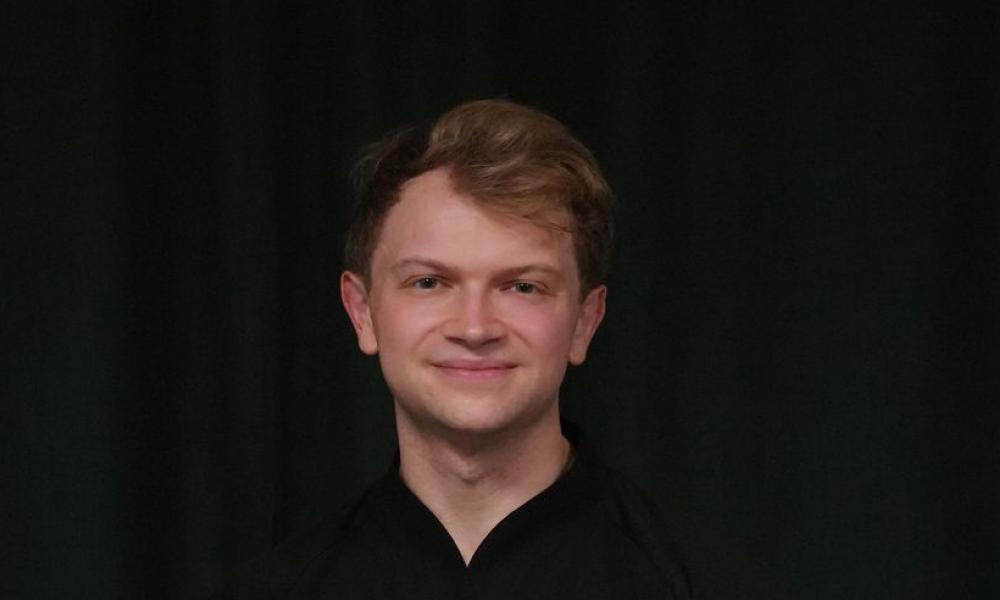
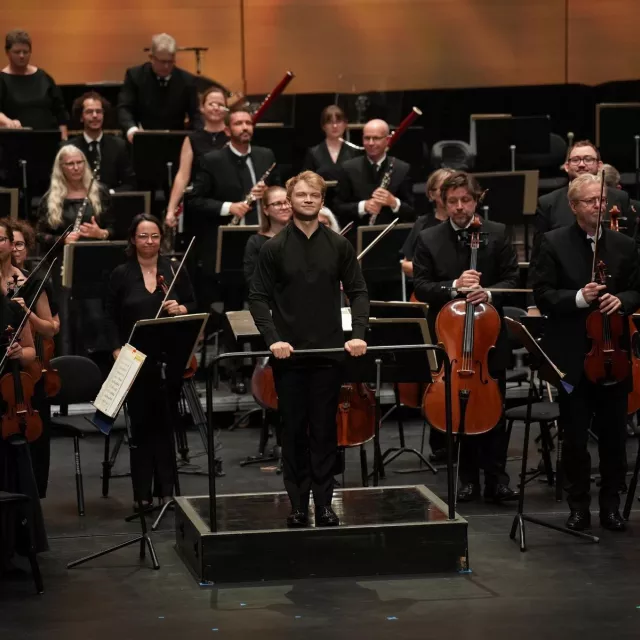
Matthew Rhodes ©TSO

Did that feeling last all the way to the final?

Not entirely! The rehearsal the day before went well, but after the general rehearsal on the morning of the final, I felt terrible. The jury had been there, and I started questioning everything: should I have done this differently? Had I got that wrong?
Before the concert, I realised I couldn’t keep obsessing over every detail. I had to loosen the reins.
There is that familiar comparison between conducting an orchestra and riding a horse: hold the reins too tightly and it cannot run freely. I told myself, “Let them go! Be there when they need you, guide the direction, but trust them.”
I think that worked. In rehearsal, you may need to be more hands-on to establish things. In the concert, there comes a point when you can step back.

What does winning mean for what comes next?

There is a concert in Trondheim to look forward to, and the competition has opened doors with other orchestras and organisations. It has created possibilities that otherwise would not have been there.
You can have all the talent in the world, but unless you have opportunities to show what you can do, you cannot build a career. I’m certainly not claiming to have all the talent in the world—perhaps just enough!
You need to work hard, study and prepare. But you also need people to hear you, to see you working, to come to a concert or a competition. All those elements have to come together. That is what makes an opportunity like Trondheim so valuable.


Matthew Rhodes, winner of the Trondheim International Conducting Competition, studied at the Sibelius Academy in Helsinki, the Royal College of Music in Stockholm and the Norwegian Academy of Music in Oslo. His engagements include the Orchestre Philharmonique Royal de Liège, Norrköping Symphony Orchestra, Gävle Symphony Orchestra and Västersås Sinfonietta. He has also assisted Simone Young with the Helsinki Philharmonic and Royal Stockholm Philharmonic orchestras.
 

©WFIMC 2026/FR