WARSAW, POLAND

Looking back at the Chopin: A Conversation with Artur Szklener

With more than 600 applicants and a worldwide audience, the International Fryderyk Chopin Piano Competition remains one of classical music’s most closely watched stages.

WFIMC: You are the “face” behind the International Fryderyk Chopin Piano Competition. Tell us about your background and your passion for Chopin.

Artur Szklener: Classical music has always been part of my life. My father is an amateur pianist and a great lover of music, including Chopin, and moments such as buying a piano, a record player or a hi-fi amplifier were always very special in our home. I studied the piano for twelve years before going on to read musicology and later complete a PhD devoted to Chopin.

The Chopin Competition takes place every five years yet organising it is clearly a major undertaking. At the same time, it forms only part of your work at the Chopin Institute. How do you balance your role as a musicologist with managing such a large national and international event?

I simply try to do my job! We have a young and enthusiastic team, and ideas are constantly emerging. Many of us have different visions and our own ideas regarding the needs of the arts, so my task is to coordinate all these initiatives and seek opportunities to implement them. Confucius famously said that you should choose a job you love, and then you’ll never work a single day in your life. That’s absolutely true. Being immersed in classical music, interpreting it and sharing it with new audiences while working with outstanding people is truly a dream job – even for a musicologist.

Last year, you had over 600 applications, for the second time I believe. How do you deal with this number, and how do you ensure that great talents don’t slip through the net?

This is one of the most important challenges of most popular competitions. It is a difficult process, and we are by no means certain that it works without any risks. During the last few competitions, we introduced a two-stage preliminary selection process: video recordings were evaluated by a committee, and then the selected candidates participated in a live preliminary round at the National Philharmonic in Warsaw. The process of evaluating recordings is particularly difficult, as it is impossible to achieve full comparability: acoustic conditions vary, as do instruments and recording equipment. That’s why in the next competition, in 2030, we intend to introduce live preliminary auditions at selected locations around the world that will then be recorded. We hope that this will make the task easier for both the jurors present at the auditions and the committee analysing the recordings.

The overall level of the competition has become incredibly high. How do you see the competition evolving?

The high level of the Chopin Competition reflects the exceptional overall standard of piano playing worldwide. Every year, hundreds of young people achieve a technical level and control of the instrument that would have been almost unimaginable to most players of previous generations. On the other hand, it also creates challenges when it comes to nurturing distinctive artistic personalities. Such rapid technical development does not always allow time for personal artistic growth, which leads to the temptation – and often even the necessity – to copy existing interpretations. And this is often audible. One of the most difficult qualities to define – yet one that audiences immediately recognise – is authentic emotion. Fortunately, music that flows from deep feeling is very different from mere imitation. I therefore believe that the most important task for all competitions today – not just the Chopin Competition in Warsaw – is to promote and seek out artistic individuality.

How would you describe the kind of winner the Chopin Competition is looking for?

First and foremost, they must be an exceptional pianist, because Chopin’s music is very demanding and every detail matters. They must have considerable stage experience and be able to handle stress, because the competition is like a marathon, and the jurors also strive to select confident artists who will represent the competition in years to come. They must have a deep understanding, or an instinctive feel, for the unique character of Chopin’s music – its intimacy, emotional intensity and vocal delicacy. At the same time, they must be able to convey the sudden outbursts of fury, the intricately woven forms and the distinctive gestures, dances and cultural references drawn from the Polish musical tradition.

Fortunately, there is an infinite number of interpretations that can meet these criteria, and what particularly pleases me is that recent juries have qualified a wide variety of personalities for the finals. It proves that there is no single model for interpreting Chopin’s scores. The “Confucian” Seong-Jin Cho, the “Arcadian” Bruce Liu, the “psychoanalytic” Eric Lu, the “intangible” Kate Liu, the “epic-lyrical” Aimi Kobayashi, the “narrative” Piotr Alexewicz and the “fairytale-like” Tyanyao Liu all present different facets of Chopin’s music in their own masterful way. They all delight audiences and are building their careers after winning laurels in Warsaw.

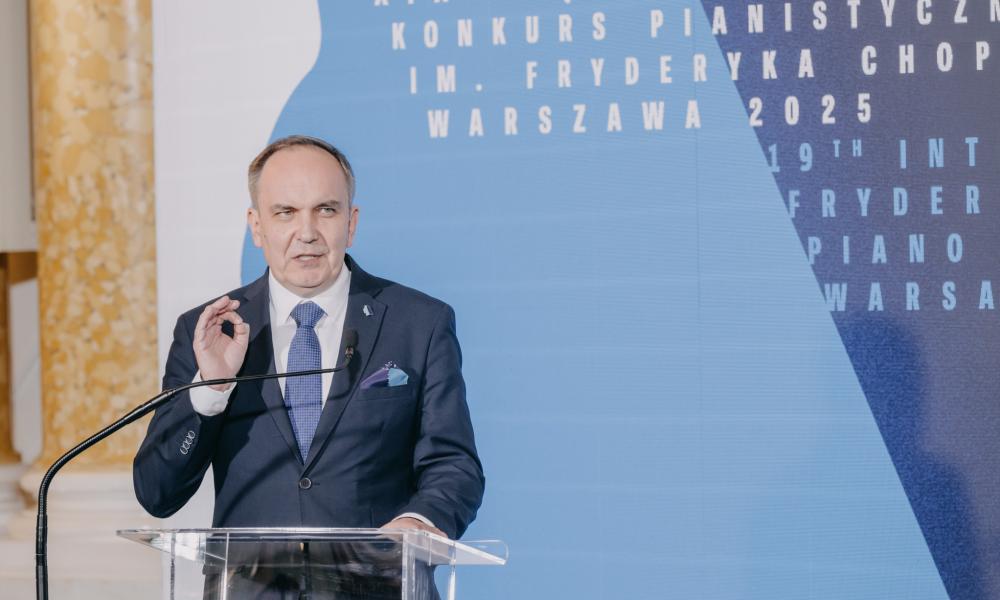
Artur Szklener at the 2025 Chopin Competition ©Grzedzinski/Chopin Institute

The competition has recently been criticised for using a complex mathematical scoring system that, while transparent, favours “mainstream” performances over possibly more creative musicians. This is not a new criticism of competitions, but the averaging of certain scores in the voting process seems to amplify the issue. How do you respond to this?

This is a complicated issue because it is extremely difficult to distinguish mathematically between deviations in jurors’ scores that are errors (intentional or not) and those that reflect legitimate differences of artistic judgement.

For decades, the Chopin Competition has applied the principle of moderate adjustment. During the last competition, we introduced a mathematical weighting system for scores in each stage to take performances from all stages into account when determining the final verdict. I am not sure whether the assumptions we have adopted favour “mainstream” performances. The verdict stems much more from the jurors’ voting than from the characteristics of the vote-counting system itself. After the scores were published, many teams analysed both our system and alternative solutions. Many experts – including statisticians and mathematicians – claim that this method is surprisingly resilient to outliers, while not overly flattening the results. I am not aware of any study suggesting that a different system would have changed the outcome of the competition.

The Chopin Competition has become a huge national event, comparable to major sports tournaments – even when you arrive at Chopin Airport, there is a pop-up store selling Chopin merchandise. In recent years, the competition has also presented laureates in a large number of concerts across Poland. How important has this initiative become?

First and foremost, we organise an eight-month global tour featuring the winners, finalists and “contest personalities” – that is, artists who attracted particular attention during the competition but did not reach the finals or win prizes. This initiative is very important as it enables us to promote young artists who performed in Warsaw and help them launch their international careers. In addition, in 2025, we organised a series of over 400 events in Poland for the first time, particularly in small towns. These were concerts and educational events for children featuring Polish participants from the Chopin Competition. This way, we can support both the artists – remembering that the competition exists primarily for them – and audiences who have only experienced classical music via online streaming and radio until now. The interest and feedback have been huge, so we are going to continue this project.

 Where do you see the future of the competition? Are you planning to work again with immersive video or other new technologies?

I’m not sure if introducing yet more new technologies to the competition is necessary. I must be getting old, since I’ve been an advocate of new solutions for nearly 20 years now. I remember perfectly well how, in 2010, we organised the first online stream on the competition’s website, and I myself moderated a discussion on Facebook, because YouTube didn’t offer live streaming at the time. That’s when the first international “virtual” community of Chopin enthusiasts and listeners of the Chopin Competition was formed, which today numbers tens of millions of people worldwide. In Poland alone, over 86 per cent of people have heard of the competition, and 48.8 per cent of adult Poles say they followed it. Today, I believe the most important thing is to sustain this community’s interest in classical music. We want to expand our offerings for our most loyal listeners and make it easier for them to attend the competition live in Warsaw, as tickets have recently sold out in seconds.

Next year, we will celebrate the 100th anniversary of the Chopin Competition. I believe that now is an opportune moment for reflection. The competition has undoubtedly fostered the artistic growth of numerous gifted young pianists from across the globe, while simultaneously introducing classical music to a wider audience. It has also demonstrated that even a deeply personal and national form of art like Chopin’s music is universal and belongs to everyone. We want to continue this mission both during the 100th anniversary celebrations, the next Chopin Competition and beyond. Stay tuned!


©2026 With friendly permission of International Arts Manager