The Enescu Competition has grown into a substantial undertaking. From your vantage point, what distinguishes it from others?
The scope is remarkable. It combines the intensity of a major international competition with opportunities for learning and professional development. Masterclasses, discussions about well-being, and contact with industry professionals all help place the competitive experience within a wider context.
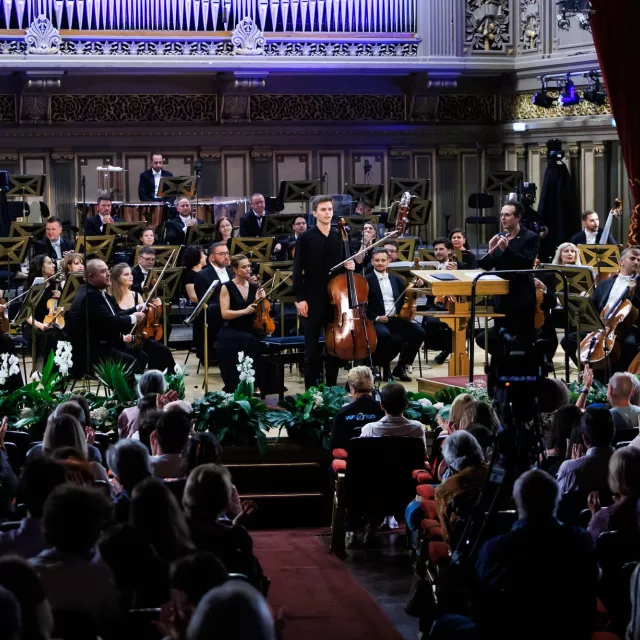
The repertoire also asks a great deal of the musicians. Moving from an Enescu sonata to leading an orchestra in a Haydn concerto requires much more than technical adaptability. These works demand different kinds of expression, different approaches to sound and phrasing, and different relationships with the musicians around you. It is an enormously challenging combination, and I admire the courage with which the competitors approach it.
That breadth allows us to hear different aspects of a musician’s personality. Someone may reveal a particularly strong sense of character in one work, then demonstrate sensitivity and flexibility in another. Those contrasts are valuable when you are trying to understand an artist rather than simply evaluate a single performance.
The other important point is that professionals are listening very carefully. The results matter, of course, but they are not the only outcome. Even for musicians who do not win, the competition can provide an introduction to people who might otherwise never have heard them.
You are a specialist in contemporary music, yet you were judging the cello competition. How did you find that experience?
It was fascinating. I love the cello—my daughter plays it—so there is a personal connection as well. But my contribution is primarily that of someone who listens across instruments and thinks about musicians within the broader concert world.
A specialist in the instrument will naturally bring detailed knowledge of its particular technical demands. My perspective is complementary: I am listening for musical identity, imagination, communication, and the potential to make a distinctive contribution to a programme.
Working with contemporary music also encourages openness. You learn to listen closely to unfamiliar musical ideas and to consider what a performer is trying to communicate, rather than judging everything against one fixed expectation. That curiosity is valuable in any repertoire.
As a programmer, I am interested in compelling musical talent regardless of age, nationality, or instrument. Competitions offer a concentrated opportunity to encounter that talent. I am already following several semi-finalists who did not necessarily reach the final but nevertheless made a strong impression. Their performances gave me reasons to want to hear them again, and that is significant in itself. What advice would you give to a young musician considering the Enescu Competition?

Prepare thoroughly, but think about the experience more broadly than the final result. A competition of this level is an opportunity to learn how you perform under pressure, how you respond to an unfamiliar environment, and how clearly you can communicate when the stakes feel very high.
You are playing alongside exceptionally gifted peers and in front of professionals with considerable experience. That can be intimidating, but it is also an opportunity to be heard with real attention. If you can work through that pressure and show your musical abilities, you have already achieved something meaningful.
I would also encourage young musicians to pay attention to the people around them. Their fellow competitors are potential future colleagues, not simply rivals. Conversations, shared experiences, and musical connections can become an important part of their professional lives.
Above all, a competition result should not be mistaken for a complete assessment of an artist’s future. It captures particular performances at a particular moment. The prize is one possible outcome; greater confidence, useful feedback, and the interest of someone who wants to follow your development are others. The process is rigorous, but its value can extend well beyond the announcement of the winners.
********
Elena Dubinets is the Artistic Director of the Royal Concertgebouw Orchestra. She previously held senior artistic planning positions at the Atlanta Symphony, Seattle Symphony and London Philharmonic Orchestra Orchestras. A musicologist and author, she brings an international perspective to artistic programming and the development of emerging talent. Her publications include Russian Composers Abroad: How They Left, Stayed, and Returned (2021), published by Indiana University Press.
©WFIMC 2026/FR